DRC: Reporting on Ebola in an information crisis
When an Ebola outbreak hits a community, people need reliable information to understand the disease, assess risks and decide where to find care. For journalists, providing this information requires more than reporting the latest case numbers. In eastern Democratic Republic of Congo, misinformation and distrust are creating an additional challenge.
A recent rapid needs assessment by ActionAid DRC across three health zones in Ituri found that only 64% of respondents believed Ebola was a real disease and not linked to spiritual or mystical causes. Only 34% could correctly identify at least three ways Ebola is transmitted. This means journalists are reporting in an environment where basic questions about the disease itself are still contested.
Raoul Kamanda, Director of PNCPS at the Ministry of Health in the DRC, stresses that the way information is communicated matters. He describes how information can either deepen mistrust or help build confidence in the response:“A lot of information can inflame a situation, distort understanding and destroy trust. Other information can build trust and buy-in.”
A long-standing information problem
This is not a new challenge in the DRC. During the 2018-2019 Ebola outbreak in North Kivu, a population-based study found that 92% of respondents had heard at least one common misinformation claim about Ebola. Almost half, 46%, believed at least one of these claims. One in four believed the statement that Ebola did not exist.
Recent monitoring indicates that misinformation remains a big problem during the current outbreak. WHO's Africa Infodemic Response Alliance has documented rumours about safe burial practices and treatment, traditional remedies and the financing of the Ebola response. Raoul Kamanda, Director of the National Program for Communication and Health Promotion (PNCPS) in the Democratic Republic of the Congo and one of the speakers in our upcoming webinar series for journalists covering the outbreak, also points to the role of traditional and religious figures in spreading false information:"There are also traditional healers or pastors who give false testimonies, false prophecies."
These rumours come from genuine questions and concerns.
According to the US Centers for Disease Control and Prevention (CDC), communities in eastern DRC have experienced 17 Ebola outbreaks since 1976, alongside decades of conflict, displacement and resource extraction. The Centre for Information Resilience recently examined how this history shapes the current sceptical response. Their research points to previous scandals and alleged abuses linked to international aid organisations, as well as low trust in health authorities and international actors. These experiences have created a deep mistrust around Ebola and the people responding to it, giving misinformation more room to spread.
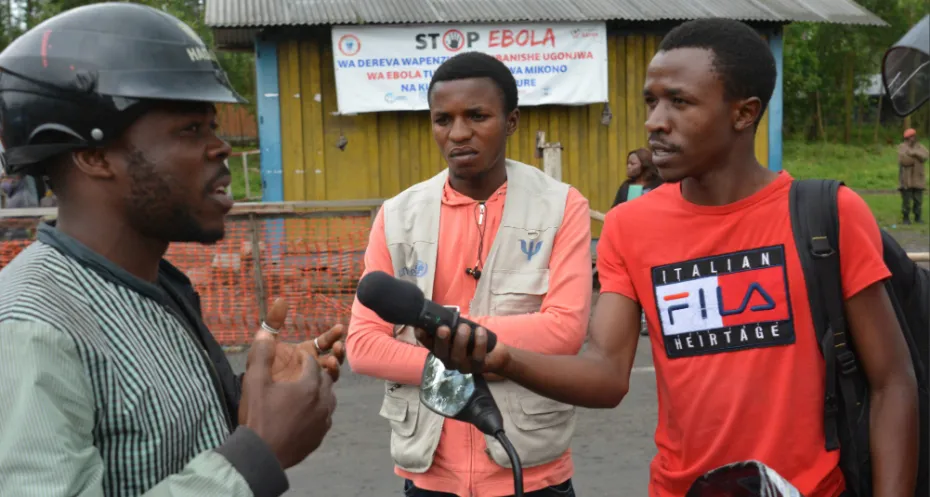
These rumours are a real problem for journalists as well. Congolese journalist Tuver Wundi has seen how mis- and disinformation can affect both journalists and the communities they work in: “Yes, there were quite a few [rumours], because people believed journalists were moving around [spreading the disease], Wundi says. “In Nyania, for example, there were protests against the response and journalists were targeted.”
The role of journalists
This makes the work of local journalists especially important. Journalists have to answer difficult questions, verify and debunk competing claims in a context where misinformation is widespread. What exactly is the virus? How does it spread? What information about vaccines and treatment is reliable? How should journalists report on deaths, survivors and burials? And what should they do when a dangerous rumour starts circulating in their community? To answer these questions, journalists need information from reliable sources and specialist knowledge. They also need to protect themselves. Journalists in affected areas also risk their own health.
Reporting on Ebola also requires journalists to understand the medical realities behind the outbreak. Popaul Nunza, Head of Communication at the National Institute for Biomedical Research in the DRC, says the absence of specific treatment for the current strain has created understandable fear.“We had neither therapy nor specific medication for this strain. When you announce a strain with no specific medication, it's frightening. That fear is understandable.” [..]. People are also skeptical. “People kept asking: ‘Why go to the hospital if there's no medicine for this strain?’”, Nunza says.
Supporting journalists on the ground
Free Press Unlimited is supporting journalists covering the Ebola outbreak in eastern DRC through a series of three practical webinars. The webinars bring together Congolese health experts, government officials and experienced journalists to address the questions journalists face when reporting on the outbreak.
The three sessions focus on:
- Understanding the disease
- Staying safe as a journalist in an affected area
- Reporting accurately and ethically
The discussions will cover both the medical and journalistic challenges of reporting on Ebola. This includes understanding how the virus spreads, identifying reliable information about treatment and vaccines, staying safe while reporting from affected areas, and dealing with rumours and misinformation.
More information about the webinars (in French)
Following the webinars, Free Press Unlimited will publish a series of practical training manuals covering the same three topics. The manuals are being developed together with Congolese infectious disease and public health experts, senior Ministry of Health officials and journalists covering the outbreak. The manuals will be available in French, Swahili and Lingala, giving journalists access to the information and practical guidance beyond the live sessions.
Reliable information matters
During an Ebola outbreak, journalists need access to reliable information and practical guidance to report accurately and responsibly. By bringing together experts and journalists through the webinars and making the knowledge available through practical training manuals, Free Press Unlimited is supporting journalists who are reporting on the outbreak in eastern DRC.