Funding cuts independent media filled by authoritarian interests
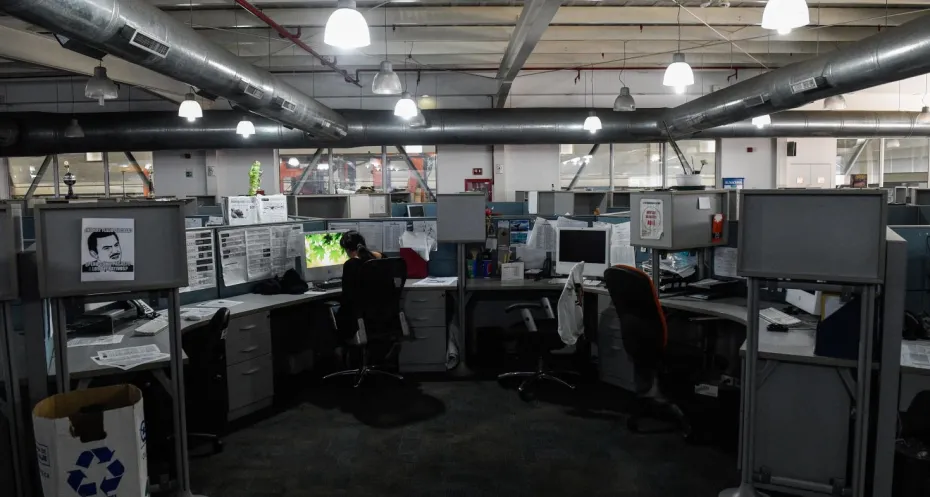
One and a half years after the US government funding cuts, support for independent media has significantly decreased across the board. The new report “The Authoritarian Utopia: The impact of funding cuts on independent media” shows that these cuts opened a gap that is being filled by authoritarian interests. This could result in noticeable geopolitical changes - also for Europe.
It is not just US government funding that has decreased, but also funding from other donors such as Sweden, the Netherlands, Germany and France. To get the most complete picture of how our partners have been affected, we surveyed them on what impact the loss of income for media outlets has had. For instance, what types of journalism were unable to continue? And what type of actors have potentially presented themselves to fund media? The respondents come from Central Asia, Eastern Europe, Latin America, Middle East and North Africa, South and Southeast Asia, Sub-Saharan Africa and Western Europe.
Survival threatened
Out of the 57 surveyed media partners, two-thirds indicated that the impact of the cuts was either significant or threatened their survival. More than a quarter of partners reported that even more than 50 percent of their annual budget was cut. 80 percent of the respondents have had to cut down on staff and salaries. Independent media have had to go through massive staff layoffs, resulting in a loss of qualified experts and weakening of diversity, skills and expertise in their team.
Journalists have been pushed out of the sector due to large salary cuts and hiring freezes, and there is a growing workload and burnout for those remaining at the media outlets. Partners report a noticeable decline in content production overall, and in particular on types of journalism that are more resource and time-intensive, such as investigative journalism, local monitoring governance, and thematic coverage on environmental justice, politics and minorities, and LGBTQ+ and gender issues.
Community media have been disproportionately impacted by the funding cuts, in particular those media outlets that serve rural areas or vulnerable communities. The increased competition over limited funding has placed pressure on organizations to align more closely with donor priorities, which may sometimes limit independence or shift focus away from local needs.
More impunity, less international pressure
The absence of resources has also limited the documentation of abuses, which favors the impunity of the repressive apparatus and reduces international pressure. Fact-checking platforms can no longer operate at scale, because they have had to lay off staff. Several partners reported a rise in the spread of harmful and misleading content, including the use of deepfake technologies and the widespread sharing of fabricated news across social media platforms, with significant public engagement in the absence of sufficient credible sources capable of rapid verification.
“Overall, these shifts contribute to a more fragile information ecosystem, where accountability is weakened, public trust declines, and space for independent, critical journalism becomes increasingly restricted.”
One of our Syrian partners.
Political consequences
The broader political consequences of this erosion are significant. Our survey shows unequivocally that where independent media decline, authoritarian interests fill the vacuum. Partners have reported on this dynamic across different continents. The boundary between domestic politics and international relations shows to be thin as well in this regard. In Pakistan, for example, our partners report that China’s ability and assertiveness in trying to export its governance model have increased.
A partner in Sudan stated:
“Following funding cuts from the USA and European donors, some alternative donors have stepped in, but their impact has been mixed [...]. Donors aligned with authoritarian interests have sought to establish their own information channels, promoting narratives favorable to the regime. This illustrates how donor diversification can both support media resilience and introduce political influence risks, depending on the source of funding.”
The autocratising world
Silencing the media enhances the possibilities of authoritarian elites to further break down other institutions. Remarkably, it’s the U.S. government funding and funding cuts by other Western donors that have now indirectly aided the opportunities for autocratic forces around the globe to erode and break down democracy further.
Journalists, activists, and organizations have lost operational capacity just when repression has intensified, increasing self-censorship and fear. The loss of reliable information as a democratic counterbalance mechanism has left citizens even more exposed to State propaganda and censorship.
Media partners report a growing dependence on alternative funding sources, which are increasingly tied, explicitly or implicitly, to political or ideological agendas. Several partners report that as independent media face financial and operational constraints, more politically aligned or less independent actors appear to have gained greater visibility as they receive robust and consistent financial backing.
Cross-border journalism fosters knowledge-sharing between regions and brings multiple perspectives on shared issues together. This holds particular importance in conflict areas, where balanced and multidirectional media coverage and exchange is essential.
Recommendations for future funding
What is needed now is a fundamental shift in how European policymakers understand support for independent media. This is not simply a matter of solidarity, nor only a normative commitment to freedom of expression. It is a strategic investment in Europe’s own security, stability and influence. For Europe, the question is therefore not whether it can afford to support independent media globally.
The question is whether it can afford not to. If the EU wants to remain a credible geopolitical actor, preserve its normative influence, strengthen democratic partners, and counter authoritarian interference, then support for independent media must be treated as strategic infrastructure: as essential to democratic resilience as election support, rule-of-law programming, anti-corruption work or cyber defence.
Read the full report here:
This research is led by Free Press Unlimited and conducted in collaboration with three media development consortia led by BBC Media Action, Internews and Free Press Unlimited.