FPU warns in post-Assad Syria: Don’t rush crucial window of opportunity for a free and independent media sector
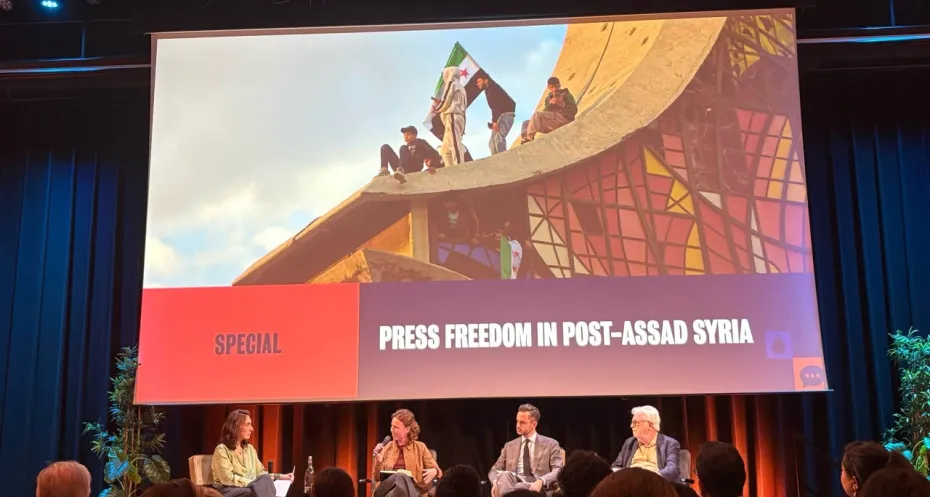
After the fall of the Assad regime, there is critical momentum to build the enabling environment for an independent media sector in Syria. Last year, Syria climbed 36 places in the World Press Freedom Index (now ranking 141st). While the situation of press freedom remains “very serious”, this is a testimony to the historical transformation that is taking place.
There are positive signals from the government that are worth engaging with, but there are also worrisome signs of increased government control over media production. Independent media are a prerequisite for durable stability and credible transitional justice in Syria. Most of all, Syrian citizens deserve to know about the atrocities committed under the Assad-regime and about what the future holds.
The opportunities: independent media a precondition for stability, accountability and public trust
After decades of oppression and censorship, the Syrian people deserve to know the facts about the atrocities that took place in the past and about the reforms that will shape the future of their country. Factual and reliable reporting by independent media contributes to the public trust, inclusiveness and transparency that is needed for sustainable reforms. This contributes to holding the government to account for the implementation of reforms, while exposing disinformation and corruption.
After years of brutal atrocities, the Syrian government cannot just turn the page. The Syrian government has indeed expressed willingness to cooperate with the international community to investigate these crimes, by granting access to official government records as well as receiving the UN investigative mechanism (IIIM). Journalistic evidence and storytelling contribute to a common narrative, reconciliation, healing and cohesion that is needed for meaningful transitional justice. Independent media furthermore play a crucial role in ensuring that accountability is achieved comprehensively: for all atrocities committed by all groups of perpetrators.
The risks: rushing into business as usual and replacing censorship with full control over media production
After the fall of the Assad dictatorship and the end of the war in Syria, the new Syrian government has a strong incentive to rapidly establish their control over the state and re-establish its ties with the international community. We currently see that the Ministry of Information is consistently increasing its control over all aspects of the media industry and regulation, rather than creating ethical and professional safeguards that ensure media independence. We observe the emergence of a highly centralised media regulatory system in which the media are both politically and economically dependent on the government, for example for obtaining their licence and for their revenues from advertising. Also for international journalists, obtaining a long-term licence has become more difficult. They are also required to provide extensive information on their planned journalistic activities. These developments put the access to independent information and editorial independence at risk.
But in fragile and post-conflict contexts, the process matters as much as the outcome. While centralisation and control may appear to bring order for the government, history shows that excessive control often reproduces repression rather than stability. Hasty policies and processes – sometimes under the guise of sovereignty or unity – risk creating a centralised, restrictive system that lacks inclusiveness and could result in new civil uprisings. In short: returning too quickly to business as usual runs the risk that censorship is replaced by full government control over media production.
15 years of involvement in Syria
Since 2011, Free Press Unlimited (FPU) has been protecting and strengthening Syrian independent media in and outside the country. We stood alongside more than 20 media organisations through some of the hardest challenges for many years. We trained more than 5,000 journalists on professional and ethical journalistic standards. We were the driving force behind the establishment of journalistic associations, institutions and alliances. Through dialogue, these partnerships became networks for collaboration and trust. We also trained the media to track and expose disinformation and hate speech, which contributed to political change.
Last September, we joined a panel at the event 'How do you build a free press after more than 50 years of dictatorship?' in Amsterdam, where we spoke with journalists from Syria and shared what the Netherlands can do to support journalists in their pursuit of press freedom.
Reflecting the highly diverse society that Syria is, we put emphasis on ensuring media pluralism. We supported diverse media across all regions that serve all types of Syrian audiences, including women, youth and minorities. The vision of these long-standing partnerships was to create the preconditions for a professional, inclusive and independent Syrian media sector to safeguard the Syrian citizens' right to access to reliable and plural information. The result is a professional network of independent journalists that can now be built upon.
A crossroad for the international community
In reshaping their diplomatic relations with Syria, the international community should prioritise supporting and strengthening existing Syrian independent media networks in shaping a plural, politically and economically independent media landscape in order to achieve sustainable and credible post-conflict stability and transitional justice. They should support the champions of dialogue to fill the currently existing space – before it is co-opted.
Our recommendations are:
• Legal reforms to decriminalise speech and strengthen journalist safety protections. Currently, liability provisions remain broad and discretionary under the 2025 Ministry of Information Law and under Cybercrime and security provisions that date back to the Assad-regime. Clear legality, proportionality and necessity conditions should be established, as well as a Freedom of Information Law with an independent appeals mechanism and effective enforcement.
• Consultation and participation. Make sure that there are open and inclusive rounds of reform talks and consultation is meaningful. Make sure that media practitioners, media experts and experienced media consumers and CSOs can genuinely participate.
• Self-regulatory media ecosystem. The Syrian government should transfer ownership to an independent, professionally-led press council with adequate complaints and accountability mechanisms. Implementation of the Code of Conduct and ethics frameworks should be owned and self-regulated by the media sector.
• Long-term, impartial licensing system with transparent, non-discriminatory criteria and judicial review safeguards. The current system of short-term and discretionary licensing undermines sustainability and enhances media outlets' dependency on the government. This can result in a lack of investment, long-term planning and professionalisation and, in the worst case, fear of holding the government to account.
• Invest in media viability and fair market regulation. Economic independence is a prerequisite for editorial independence. Transparent advertisement laws and independent oversight over advertisement regulation are needed to ensure fair competition on media markets, and protect access to domestic and foreign funding for NGOs and media.
• Promote media pluralism, including by supporting local media outlets. With their longstanding experience and deep-rooted knowledge of the Syrian context, local media form a critical part of an inclusive, sustainable and just media landscape in a post-conflict Syria and play a crucial role in trust-building among diverse groups of Syrian citizens across the country.