The EU Democracy Shield: Does it shield us enough from today’s challenges to our democracies?
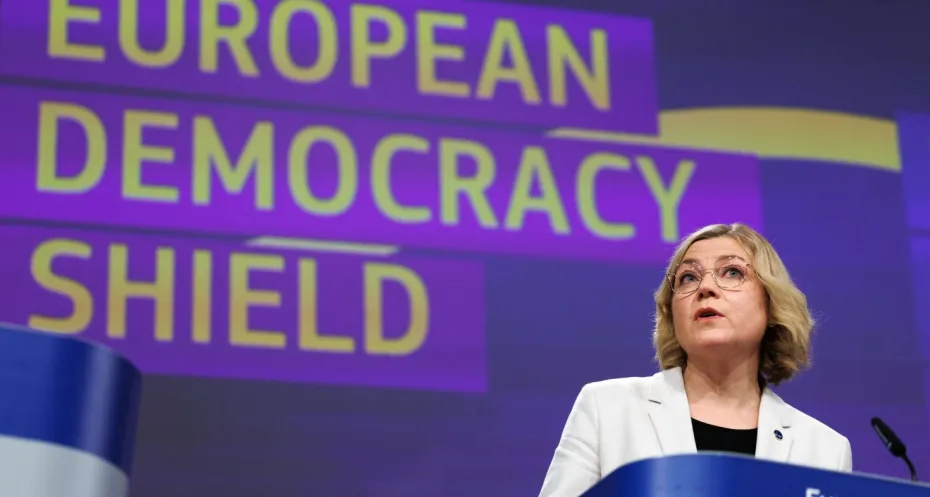
Today, the European Parliament will discuss the Special Committee's report on the EU Democracy Shield, a comprehensive package of policy measures through which the European Commission aims to protect and empower democracies within and outside the European Union. Building democratic resilience is a core focus of this policy agenda, the urgency and pertinence of which unfortunately does not require much explanation.
The quickly unfolding new world order is one where democratic values such as the rule of law, independence of institutions and press freedom are increasingly challenged by major powers. A prominent example is the void caused by the withdrawal of USAID support to independent media in Eastern Europe, giving free rein to Russian propaganda and disinformation, rapidly amplified and multiplied to unprecedented volumes by technology.
While the European Democracy Action Plan (2020) responded to growing extremism and digital transformation within the EU, resulting in major binding legislative frameworks such as the Digital Services Act (DSA) and the European Media Freedom Act (EMFA), the Democracy Shield adds a new element to the equation. The – not coincidentally titled – ‘Shield’ aims to protect European democracies against interference from autocratic regimes and geopolitical powers that seek to disrupt or undermine independent media and information ecosystems. It recognizes democracy not only as a European value, but also a prerequisite for EU unity, prosperity and security – and thus an integral part of its strategic autonomy.
The European Commission rightly places independent media and information at the heart of this effort. In fact, they should be treated as critical infrastructure. Accurate and timely information is essential for informed public response to cyber attacks or foreign influence operations and crucial for autonomy, trust and cohesion in European societies. The Shield therefore embodies a powerful approach by addressing democracy protection comprehensively, with measures across all policy areas - from human rights and enlargement policies to defense spending. But while laying out a critical political direction, further operationalisation is needed to effectively tackle the threats that prompted the Shield in the first place.
Together with partners from the Media Freedom Rapid Response consortium, we therefore call upon Members of the European Parliament to strengthen and expand the political commitments made in the Shield and to translate them into concrete actions with an established timeline. Measures should not only be of a reactive nature, but provide for durable and well-coordinated investment and protection.
In particular, FPU welcomes the continued prioritisation of the safety of journalists with adequate core funding for independent media and media in exile, including scaling up rapid response. For durable and proactive investment in independent information ecosystems, these intentions need to be anchored adequately in the Multi-Annual Financial Framework, including in defense spending. The Shield should also better anticipate the increase of online violence and harassment against journalists by developing enhanced protection and accessible appeals mechanisms to enforce the DSA. The importance of uncompromised enforcement of the DSA to protect democracies against mounting pressure cannot be understated. We recommend a risk assessment that is reflective of the actual needs of journalists on the ground to formulate more concrete steps to ensure implementation of the DSA.
In order to remain a safe haven for journalists that increasingly face repression worldwide, the EU should step up its protection for journalists in exile by providing longer term relocation and by setting up partnerships with media outlets in host states to create work and network opportunities. Notably, the recognition of the threat posed by transnational repression is currently lacking from the Shield, whereas this is a growing cross-border threat against journalists that requires a coordinated EU response.
The Shield’s commitment to combat Strategic Lawsuits Against Public Participation (SLAPPs) is critical. Besides strengthening compensation for legal, economic and psychosocial damages suffered by targeted journalists, support should be made available to prevent their financial collapse as a result of these lawsuits. The EP report rightly calls for an evaluation report on the implementation of the Anti-SLAPP Directive. Given the lagging compatible and timely transposition close to the final deadline, we also recommend more regular engagement with national focal points, training and awareness raising and - in case of failure - an infringement procedure.
A core focus of the Shield is to address foreign information manipulation and interference and disinformation, including through the establishment of the European Centre for Democratic Resilience. We fully support the EP report’s call for making the Centre a fully-fledged EU body with a clear operational mandate and budget. A formal consultation process for CSOs should be set up to inform this effort. Moreover, the Centre should not only be reactive but also be equipped with robust forecasting capacity to analyse, predict and anticipate disinformation trends.
Read the full list of proposals here.