Bangladesh: Media and civil society organisations join forces, with results
Three years ago, Free Press Unlimited (FPU) launched The Collaboration Lab: a program that brought journalists, media, and civil society organisations in Bangladesh together around themes that directly impact citizens' daily lives. With support from the European Union, we created 21 alliances among 54 media and civil society organisations across Bangladesh. The goal: greater accountability of governments and institutions, better access to reliable information, and a stronger voice for local communities.
Three years later, the results are visible. Citizens know better how to raise issues, local authorities respond more frequently to signals from society, and reliable information reaches more people. An independent evaluation confirms that the collaboration between media and civil society organisations played a key role in this.
From local concerns to concrete changes
When journalists and civil society organisations join forces, they prove to achieve more than they would alone. By joining forces, isolated complaints and signals from communities grew into well-substantiated dossiers that enabled organisations to put problems on the agenda and drive change. Issues that received more attention were taken more seriously by authorities and found their way to decision-makers more easily.
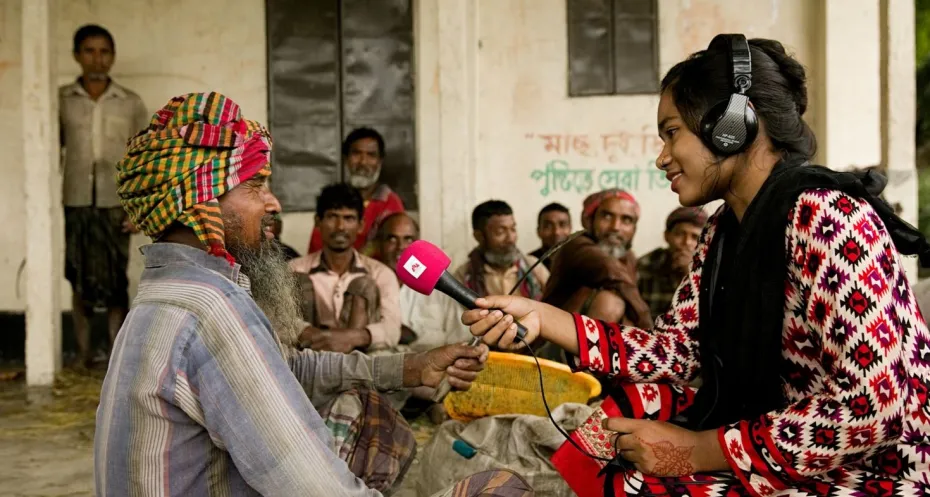
In North Bangladesh, this led to tangible results. Community radio stations - local radio stations that produce programs with and for a specific community - collaborated with local organisations and minority groups to make community issues visible. Through radio programs, citizens could ask questions directly to experts and government representatives, ensuring that problems were not only discussed but also followed up on.
That made a difference. After attention was drawn to a shortage of safe drinking water during a broadcast, a government official visited the community to investigate whether a water well could be constructed. In another community, the local government made land available for a crematorium. Elsewhere, the government granted permission to establish a youth club to preserve the community's language and culture. These examples show what is possible when communities, media, and civil society organisations work together on the same challenge.
Read also: Community radio gives minority communities a voice in Bangladesh.
Reliable information is more accessible
Everyone has a right to reliable information and must be able to access it. Therefore, the various alliances developed diverse journalistic products: from investigative journalism and digital platforms to local information initiatives and tools that enable citizens to hold governments accountable. The evaluation shows that this approach was particularly successful when information not only informs people but also helps them to take action.
For example, one alliance developed the Civic Defenders of Bangladesh platform, a digital knowledge base in which media, civil society organisations, and academics collaborate. The platform offers journalists, researchers, and activists access to substantiated information and practical tools that will remain available even after the project ends (until April 2026).
Another alliance focused on healthcare accessibility. In addition to organising awareness campaigns, it installed seven permanent information boards listing all 54 available health services. This gives citizens insight into their rights and a practical tool to claim those rights when service provision falls short. The initiatives differ greatly from one another, but have one thing in common: making reliable information accessible and usable for citizens.
Trust grows through engagement
The program ran during a period when disinformation began to play an increasingly large role in Bangladesh. Precisely because of this, the importance of reliable information and strong relationships among communities, media, and civil society organisations only grew.
According to the evaluation, people were increasingly willing to engage in dialogue with journalists and civil society organisations, participating in meetings, raising new issues, and sharing personal experiences. Trust grew especially when people saw that their concerns were taken seriously and that something was actually done about them.
Lasting change, even after April 2026
The Collaboration Lab ran until April 2026. However, the program’s impact did not stop after the individual projects or campaigns. Much of the accumulated knowledge, collaborations, and working methods remain. The evaluation shows that participating organisations have strengthened their professional standards and begun collaborating in a more structured manner.
Smaller civil society organisations and local media, in particular, developed stronger organisational processes and working methods that will continue to support them going forward. One of the alliances succeeded in making reporting on the Hijra community, a community that does not identify as male or female, more inclusive. The collaboration resulted in an inclusive media policy intended to contribute to more respectful and accurate reporting. Five media organisations subsequently committed to implementing the recommendations.
Read also: Media as a driving force for greater inclusivity of the Hijra community in Bangladesh
Other project results also live on. The Civic Defenders platform remains available to researchers, journalists, and activists. Young people involved in the community radio initiative indicated that they wish to continue volunteering even after the project has ended. In addition, many participants want to continue and further expand the collaborations that originated within The Collaboration Lab.
Change happens faster when you work together
The conclusion is clear: when media and civil society organisations join forces, they can achieve more for citizens together than separately. Together, our partners helped communities in Bangladesh bring their concerns to the attention of decision-makers and increased access to reliable information.