Only 1 percent of the world’s population lives in a country where press freedom is categorized as ‘good’
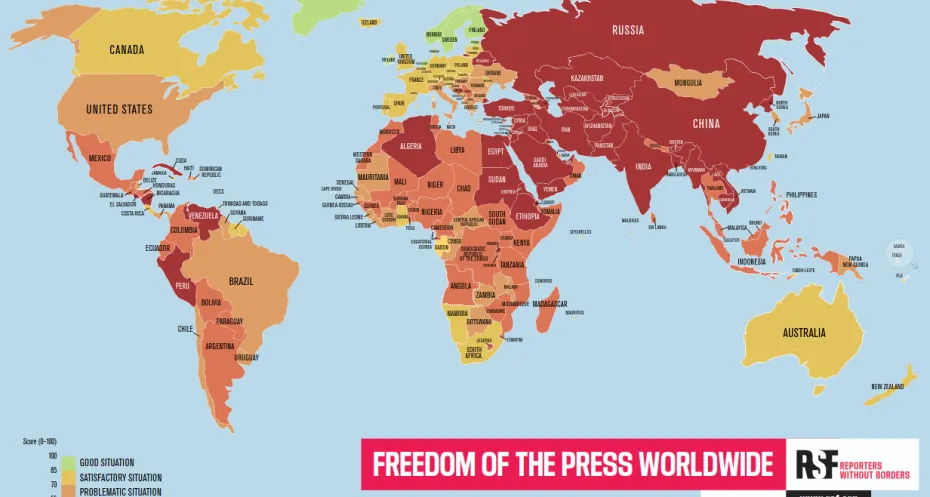
For the first time in the history of the World Press Freedom Index, compiled annually by Reporters Without Borders (RSF), more than half of all countries in the world now fall into the ‘difficult’ or “very serious” categories in terms of press freedom. In 25 years, the average score of all 180 countries and territories in the ranking has never been this low. Only 1% of the world’s population lives in a country where press freedom is categorized as ‘good’. In 2002, that was still 20%.
Criminalization of Journalism
An important reason for the deteriorating global situation is increasingly strict legislation that has been applied since 2001, the year of the 9/11 attacks, that erodes the right to information. This is done in the name of “national security.” This trend, which is particularly prevalent in authoritarian regimes, is also gaining ground in democracies and is typically accompanied by the suppression of journalists’ freedom of information, particularly under the guise of counterterrorism.
Free Press Unlimited urges the European Union to allocate 150 million euros from its 800-billion-euro defense budget to protecting independent media. “Security is not just about military strength, but also about access to independent information for a resilient society”, says Free Press Unlimited director Ruth Kronenburg.
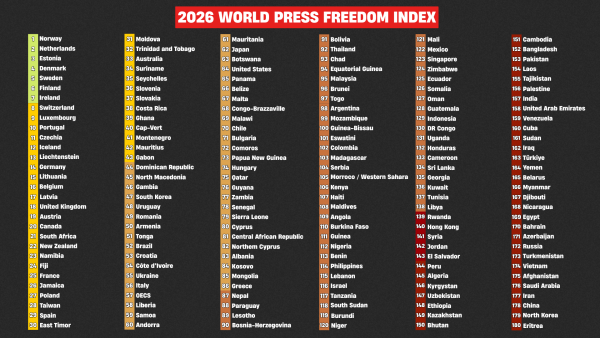
Another legal threat to journalists is the rise of so-called SLAPPs, strategic lawsuits against public participation. The abuse of legislation also occurs in relatively high-ranking countries, such as France (ranked 25th).
Free Press Unlimited is part of the Coalition Against SLAPPs in Europe (CASE), a coalition of 80 NGOs that advocates at the policy level to protect civil society and journalists from these types of intimidating lawsuits.
So far, the World Press Freedom Index shows that government policies have failed to provide structural solutions to the many challenges journalists face worldwide, such as physical or legal threats. In more than 80% of countries, measures are considered non-existent or ineffective.
Erosion
European legislation on media freedom is regularly undermined by national legislative proposals, as was the case in Hungary (ranked 74th) under Viktor Orbán’s outgoing government, and also in higher-ranked countries such as Slovakia (ranked 37th), Lithuania (ranked 15th), and the Czech Republic (ranked 11th).
Despite all the geopolitical tensions, Europe largely remains at the top of the list, although the average score across all countries has never been lower. This is also reflected in North and South America, where the United States have dropped seven places since President Trump took office. This shift has a broader legitimizing effect on the suppression of the independent press. Trump’s Latin American allies, such as Milei of Argentina and Bukele of El Salvador, have further tightened their grip on the media, following the American example.
The Fight for Press Freedom
Fortunately, there are also countries that are able to fight the trend. Around the world, we support courageous journalists who play a crucial role in ensuring our access to reliable information and who have contributed to positive democratic changes.
Syria has shown the greatest improvement since Assad’s fall, rising 36 places in the rankings. This can be attributed to positive legal reforms that have significantly improved working conditions for journalists after years of systematic attacks on the press. Free Press Unlimited has been working in Syria since 2011 and has continued to support journalists during the fragile transition period following Assad’s fall. A key milestone in our work is the development of an ethical charter for the media, created in close collaboration with 270 media professionals. Free Press Unlimited also advocates with the EU and the Syrian government for reforms that will ensure an independent media sector in the new state.
Organizations like ours provide support to journalists, ranging from safety training to legal assistance. We also advocate at the policy level for better protection of journalists. Press freedom is not a given; it must be constantly protected and fought for. Only together can we preserve a free press.