Journalism will not be intimidated (and neither will Free Press Unlimited)
Free Press Unlimited (FPU) is committed to protecting journalists and press freedom. In doing so, not only they but we as an organisation are also increasingly facing intimidation and pressure from actors seeking to silence us. As a press freedom organisation, we have a responsibility to make visible what that pressure looks like and what its impact is. Even when we experience it ourselves. That is why, for the first time, we are publicly sharing our own experiences.
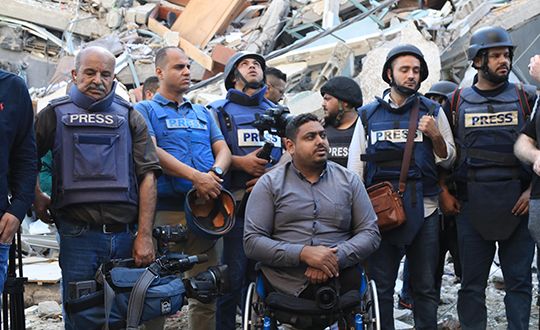
On 22 December 2025, the Centre for Information and Documentation on Israel (CIDI) filed a complaint against us with the Dutch Advertising Code Committee. In this complaint, CIDI accused our organisation of “misleading” communication in a fundraising letter about the safety of journalists in Gaza, despite the fact that the information in the letter was based on widely shared reporting from international organisations. Free Press Unlimited supports journalists in Palestine by providing work equipment, psychosocial support, and other resources to ensure they can continue their work. In the letter, we asked for support to sustain these efforts. Following a hearing on 5 February, we received the Committee’s decision on 24 February: the complaint was rejected.
In September 2023, a criminal complaint was filed against one of our colleagues in a personal capacity by a former Greek police officer. This followed an email in which we asked for a right of reply in the context of our investigation into the murder of Greek journalist Sokratis Giolias. In the complaint, our request for comment was characterised as an attempt at “illegal (online) violence.” To our surprise, the Greek Public Prosecutor accepted this reasoning and opened a criminal investigation. It was only in January 2025 that the case was definitively dismissed, and our colleague was no longer subject to prosecution. For us, this confirmed what had been clear from the outset: these were entirely standard journalistic questions posed by our investigation team.
These cases are not isolated incidents. Nearly half of Dutch journalists have faced threats of legal action following publication. The use of lawsuits to intimidate journalists and media makers, known as SLAPPs (Strategic Lawsuits Against Public Participation), is also on the rise. This is deeply concerning. Such pressure can lead to financial strain, significant time investment, and psychological stress. In some cases, as Free Press Unlimited research shows, it even leads to self-censorship: stories are softened or not published at all. This effect stems not only from legal proceedings themselves, but also from the threat and the resources required to respond to them.
In our own cases, we also had to seek legal assistance, and several colleagues invested substantial time preparing for proceedings and attending hearings – time, money, and energy that would otherwise have gone towards our core work. When journalists are intimidated or threatened, this is not only a problem for media organisations; it directly affects the public’s right to reliable information.
“Legal pressure does not exist in isolation. We see it as part of a broader global trend towards autocratisation, in which silencing civil society organisations and independent media is a deliberate - and often effective - objective,” says Free Press Unlimited director Ruth Kronenburg. Research by Free Press Unlimited in 2024 on legal pressure in Dutch journalism shows that such pressure often remains invisible to the public.
We welcome the fact that Dutch media outlets such as Follow the Money, NOS and Zembla are increasingly making these forms of pressure public. Follow the Money has shared that it receives weekly emails from law firms acting on behalf of clients objecting to (forthcoming) publications. The editorial board of NOS Nieuws also published an article in response to legal proceedings, stating that the broadcaster is “increasingly confronted with unfounded allegations.” A recent case against Zembla illustrates how far such pressure can go: only after years of litigation did the Dutch Supreme Court confirm in October 2025 that Zembla’s reporting was lawful and that the public interest outweighed the company’s reputational concerns.
Free Press Unlimited does not do its work only for journalists in Gaza or for the colleagues of Sokratis Giolias in Greece. The information we share about the safety of journalists concerns you as well: every journalist who is silenced can no longer inform you about the world around you. Legal pressure makes it harder to bring you that information. That is precisely why we are choosing to speak out. Above all, we want to make clear that we will continue to advocate for stronger legal protection against SLAPPs, for the safety of journalists, and for access to independent information.