Reporting gender-based violence in Somaliland
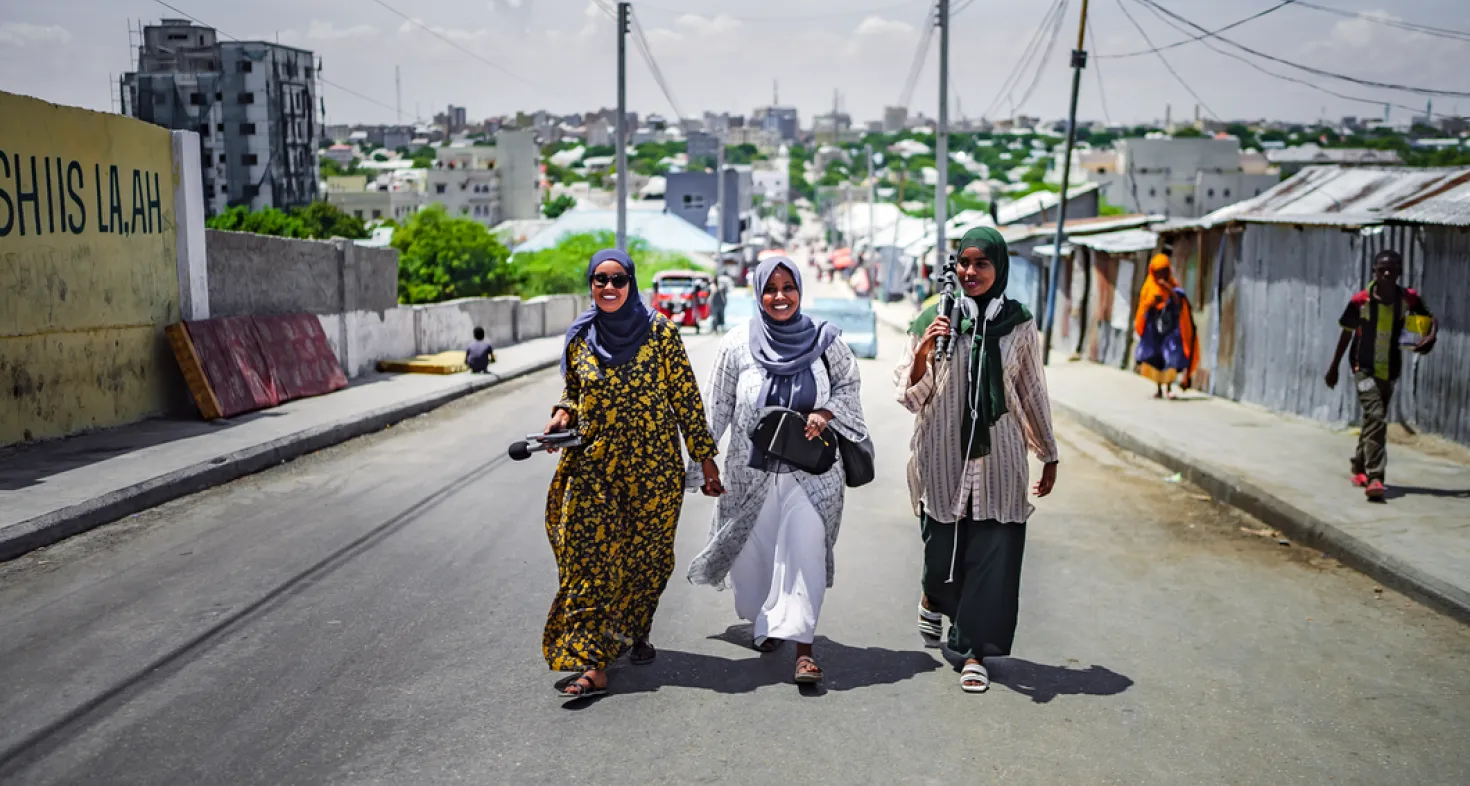
Journalism in Somaliland is changing. Where reporting once focused primarily on official statements and breaking news, a new generation of journalists is beginning to tackle complex, sensitive issues with greater depth, ethics, and care. Supported by targeted training and production funds, young journalists are increasingly entering spaces that were long considered inaccessible, including displacement camps and conversations around gender-based violence.
One of them is Fatima Mohamed, a young Somali journalist whose recent video reportage was selected for screening at the African Women in Media Conference 2025. Fatima’s film was produced as part of a media development initiative, called the Danwaadag project, supported by Free Press Unlimited (FPU) fund, carried out in partnership with the Somaliland Journalist Association (SOLJA), VNG, MAP, Care and Media Ink.
Her work is not only a story about women affected by displacement and violence. It is also a reflection of how journalism in Somaliland is evolving: becoming more professional, more inclusive, and more willing to confront difficult realities responsibly.
In a context marked by climate change-induced displacement, cultural taboos, and limited safety for both journalists and their sources, Fatima’s reportage demonstrates how ethical, survivor-centred journalism can create space for voices that are often excluded. And why women journalists play a crucial role in telling the full story.
Motivation: climate change and displacement
When Somali journalist Fatima began working on her latest video reportage, she was responding to a reality that is both urgent and largely invisible. Across the Horn of Africa, prolonged drought and famine have forced mass displacement. In Somaliland alone, tens of thousands of people now live in informal camps, where insecurity and scarcity shape everyday life. For women, these conditions often come with an increased risk of gender-based violence and with very few safe ways to speak about it.
“As a journalist and a social worker, I felt a responsibility,” Fatima explains. “Displacement is usually discussed in terms of food, water, and shelter. But what was missing from the public conversation was what women were experiencing inside these camps.”
According to World Bank figures from 2021, around 1.4 million people in Somalia have been displaced due to drought and famine. In the camps, Fatima observed weak security, poor lighting, and overcrowding. Conditions that increase women’s vulnerability to sexual violence. Yet cultural stigma and fear of shame often prevent survivors from reporting abuse, let alone speaking to the media.
“This report was about making women visible,” she says. “About giving space to survivors of gender-based violence to tell their stories in their own voices.”
Watch the full documentary below.
Access to victims, trust, and ethical reporting
Gaining access to survivors required patience and trust. Because how do you approach women who have been gang-raped and shunned by their family because of it?
Fatima did not approach women directly at first. Instead, she worked through local service providers, government ministries such as the Ministry of Family and Social Affairs and the Ministry of Resilience, and community-based organisations that already supported survivors.
“Many women are afraid,” she explains. “Families and communities may discourage them from speaking because of shame and stigma. My background as a social worker helped me understand how to approach these stories carefully and respectfully.”
The result is a reportage that centres women’s experiences without sensationalising them. This is a balance that is difficult to achieve in a context where gender-based violence is deeply taboo.
A project rooted in media development
Fatima’s reportage was presented at the African Women in Media Conference 2025, during a panel hosted jointly by the Somaliland Journalists Association (SOLJA) and Free Press Unlimited (FPU). The session highlighted the urgent realities of gender-based violence and displacement.
“Seeing this topic discussed on an international stage is deeply affirming,” Hadia Dahir, Program Officer at SOLJA says. “It validates the courage of Somaliland women journalists who are reporting on complex and sensitive issues, often under difficult conditions.”
The project selected ten journalists through an open call distributed across Somaliland. Applicants were invited to pitch stories under two thematic tracks: Disaster Risk Management and Gender-Based Violence. Out of 48 submissions, ten journalists were chosen, of which seven focusing on disaster-related reporting and three on gender-based violence (GVB).
“The process was transparent and competitive,” Hadia explains. “We strongly encouraged women to apply, and we supported the selected journalists with mentoring from an external journalism consultant.”
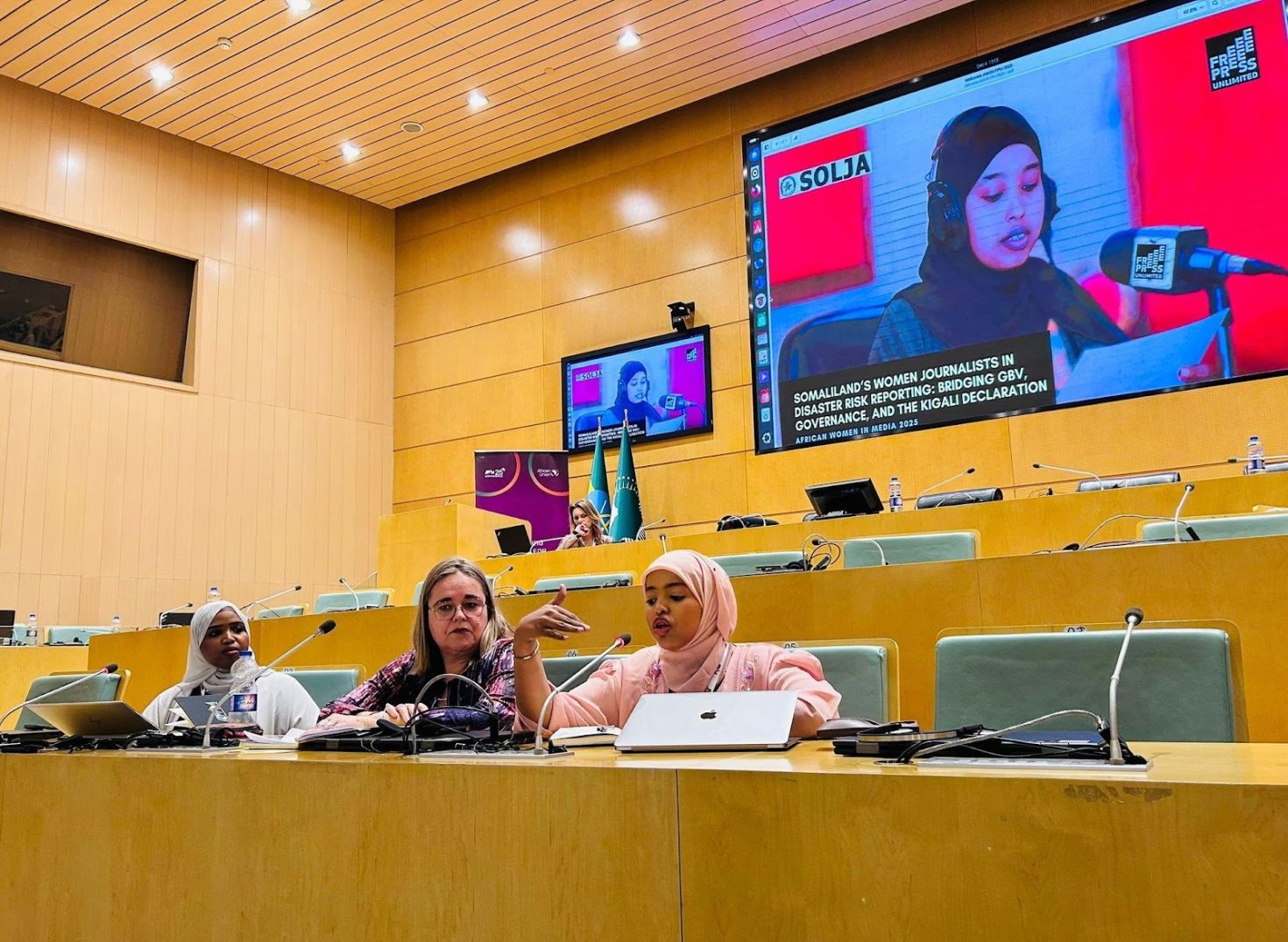
Fatima Mohamed, Hadia Dahir (SOLJA) and Fenke Elskamp (FPU) speaking at the African Women in Media Conference 2025.
Why women journalists matter
While SOLJA works with journalists of all genders, Hadia is clear about the importance of women leading GBV reporting.
“In our context, it is extremely difficult for male journalists to report on sexual violence,” she says. “Women survivors are much more likely to speak openly to a woman journalist. Cultural norms, trauma, and trust all play a role.”
Rather than offering a standalone GBV training, SOLJA focused on strengthening ethical reporting practices more broadly. Journalists were encouraged to apply principles of privacy, respect, and cultural awareness, drawing both on professional standards and their lived understanding of Somali society.
Journalism in transition
For Hadia, Fatima’s work reflects a wider transition within Somaliland journalism. While the sector is still developing, projects like this one demonstrate growing professionalism and ambition, particularly among women journalists.
“We are seeing progress,” she says. “There is better reporting, stronger editorial practices, and more willingness to enter sensitive spaces, like displacement camps, to tell the full story.”
She emphasises that without women journalists, critical parts of the story remain untold. “If women are missing from journalism, then half the reality is missing.”
Looking ahead, Hadia sees the future of journalism in Somaliland as both more inclusive and more technologically adaptable. “The world is changing. Journalists need to work across traditional media and digital platforms. Everyone with a phone can publish, but professional journalism still matters.”
Speaking beyond the camps
For Fatima, the impact of the reportage goes beyond visibility. By placing women’s experiences of gender-based violence within a wider story of climate change, displacement, and social breakdown, the film challenges audiences to see GBV not as isolated incidents, but as a systemic issue.
“This is not just about individual stories,” she says firmly. “It’s about how drought, poverty, and insecurity intersect, and how women carry the heaviest burden.”
As the film is screened at African Women in Media 2025, both Fatima and Hadia hope it will prompt journalists, policymakers, and international organisations to ask harder questions. Not only about gender-based violence, but about whose voices are heard when crises unfold.