‘This was the hardest campaign of my career’: witnessing Serbia's elections on the ground
Free Press Unlimited was on the ground in Belgrade this Sunday to cover journalist safety and monitor attacks against journalists during the elections of October 25th 2026. Our colleague Jasmijn de Zeeuw wrote an hour-by-hour report of what she experienced on this election day, which would turn out to be a turning point for Serbia.
We are walking past the Parliament building in Belgrade in silence, passing groups of ‘Ćaci’ dressed in black hoodies every few meters. They are pro-government supporters who have occupied the Pionirski Park opposite the Parliament for over a year with police protection. Journalists coming too close to the so-called Ćaciland were regularly attacked, and the last newsroom we visited around 8:30pm explicitly warns us to not speak English around them. Not more than an hour later, the situation on the same street has changed completely. What starts with a few honking cars quickly turns into unequivocal headlines: “Aleksandar Vučić admits defeat”. Free Press Unlimited was on the ground on Sunday, October 25th, to cover journalist safety during the Serbian elections. A report of what could turn out to be a turning point for media freedom in the country.
Free Press Unlimited and its predecessors have worked in Serbia and the Western Balkans since the 1990s, but in the past two years, our work was dominated by emergency support and crisis advocacy. Together with Serbian partners and colleagues in Media Freedom Rapid Response, we regularly visited Serbia and raised the alarm about rising physical attacks against journalists, the complete state of impunity, and the undermining of media pluralism.
Since the beginning of 2026, the Media Freedom Rapid Response (MFRR) has documented 157 attacks, affecting 261 journalists and media workers in Serbia. These numbers include a steep rise in online death threats. Journalists covering previous elections were also physically attacked, beaten, had their equipment destroyed and faced threats against their families. The electoral campaign put even more pressure on journalists, with physical attacks, death threats and obstruction targeting reporters covering the elections. Political figures, including state officials, regularly added fuel to the fire with inciting hate speech, SLAPP-suits and regulatory action against media.
In a largely captured media landscape, this placed the remaining independent media who continued to cover the growing student movement in a crisis situation. Upon the invitation from the International Journalist Association of Serbia (IJAS/NUNS), we decided to cover the elections in-person to monitor any attacks against journalists and express solidarity with independent media.
10:00 - I meet with Massimo Moratti, correspondent for OBCT, who lives in Belgrade. We are covering the elections together. It’s a joyous reconvening: Massimo faced an expulsion order from the Serbian authorities only weeks before, which was withdrawn after sustained international pressure. We are going on newsroom visits throughout the day, and start our day at a polling station in Belgrade.
The turn-out is already at 27%, nearly a doubling compared to the elections of 2023.
11:00 - We gather at the office of the International Journalist Association of Serbia, which is open all day to journalists covering the elections. The first reports of journalists barred entry from polling stations across the country are coming in, as well as a physical attack against journalists in Pavlovac. The turn-out is already at 27%, nearly a doubling compared to the elections of 2023.
12:30 - We leave for a series of newsroom visits together with journalist and NUNS-member Marina Rakic. Vera Potparić, editor-in-chief of news agency FoNet states what we will hear from many media today: ‘It was one of the hardest campaigns for journalism. As media, we want to cover all sides and parties, but we were regularly not allowed access to events by SNS (Vučić’ party). SNS and government officials did not reply to any of our invitations or questions during the campaign’.
Executive Director Irena Pejić from Mašina tells us several of their reporters have already been refused entry to polling stations in four cities.
13:00 - Walking to the offices of online platform Mašina, we see the blockade of the streets leading up to the election committee RIK. The street has been blocked for several weeks, and even accredited journalists are not always let through in the afternoon. Executive Director Irena Pejić from Mašina tells us several of their reporters have already been refused entry to polling stations in four cities.
14:00 - Several independent media were hit with bot attacks in the days before the elections, intended to cause account suspension. Newspaper Danas also faced DDOS-attacks on its website, and tells us about the online harassment several of its reporters faced following incitement by pro-government tabloids and government officials. As others tell us as well today, the use of terms like ‘foreign mercenary’, ‘nazi’, or ‘traitor’ for the media have led to a wave of online threats and hate.
15:00 - In the afternoon, we start hearing rumours that the new owners of the independent channels N1 and Nova.tv have requested to be present in the newsroom during the election night broadcasts. A request that is received with suspicion, following months of tension and worries about the editorial independence of the titles in the former United Media group, including Nova.rs. In August 2025, OCCRP published a leaked phone call between the CEOs of United Media and Telekom Srbija, a close ally to Vučić, in which they discussed undermining the independence of N1.
As Slobodan Georgiev, news director of Nova.tv, tells us, the consequences were felt at Nova.tv as well. He reveals he was asked to quit at the start of the electoral period, but refused. For tonight’s visit by representatives of the new owners of Alpac group, he has stated they are welcome, but will not be allowed access to the control room. We discuss that the outcome of the elections tonight will quite likely determine the future of outlets like Nova.tv - the new owners have submitted a request for a Serbian media license from the controversial media regulator REM. If accepted, they will likely lose much of the protection against interference with the editorial line offered by the current registration in Luxembourg.
While dusk is setting, we see armoured police with shields emerging from a tour bus.
17:00 On the way to Nova.rs, while dusk is setting, we see armoured police with shields emerging from a tour bus. On the news, we see that armoured vehicles have been seen entering Belgrade and police presence in the centre is increasing. People are speculating about the reason and what will happen in the next hours, suspecting that the police activity is a response to the high turnout. The polling stations are open until 20:00 today.
18:00 At Nova.rs, we meet with deputy editor-in-chief Ratko Femić. The newsroom has faced turbulent weeks. Femić describes that their editorial line was not attacked openly, but through interventions packaged as ‘professional standards’ or ‘commercial decisions’. The cuts to their social media budget by the new owners led to a decrease in the unique viewers on their site, while they managed to keep other metrics, such as time spent, stable. At the start of the electoral period, the chief news executive appointed by the new owners, Brent Sadler, offered them additional staff for a period of three months.
The newsroom refused upon discovering that many of the journalists on the list previously worked for pro-Kremlin or pro-government media. Last week, the newsroom was offered an 48 hour-ultimatum: cooperate with the appointment of a new editor-in-chief and deputy editor or leave the company. Following an internal vote, 98% decided to stay and refuse cooperation with the new management.
19:00 With the polls closing in an hour, predictions are growing more frantic. The high turnout could point at a student victory, but the firm police presence and re-occupation of Ćaciland lead to fears about what will happen tonight. We continue our visits to the studios of N1, where reporters are preparing for the live broadcast of the election night. News director Bane Šovljanski tells us that the election day has been relatively quiet, but confirms that, unlike prior years, N1 is among the media refused access to the SNS headquarters during the election night.
We watch thousands of Serbians gather, dance and cry at Slavija square.
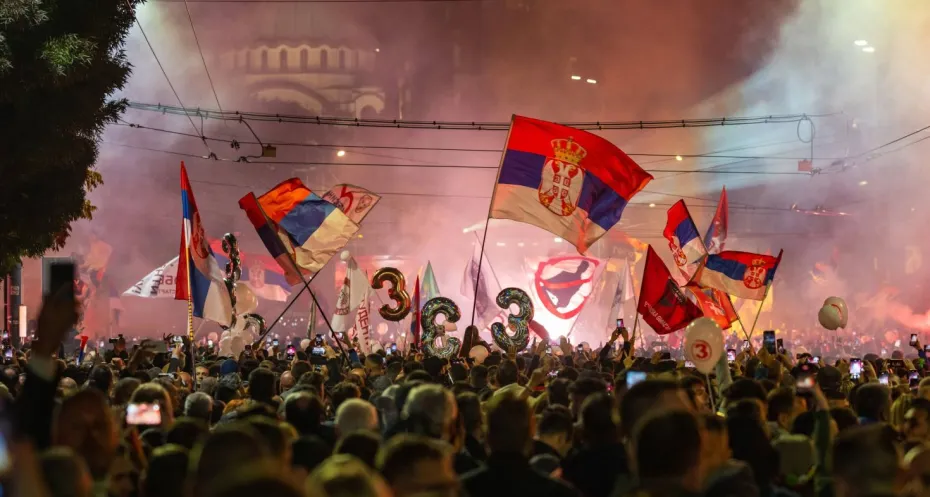
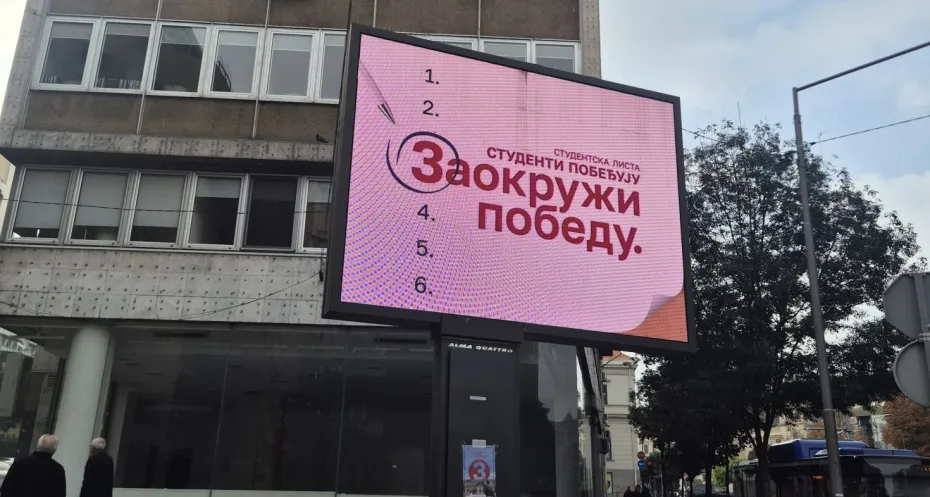
21:35 Following two more visits to Vreme and news agency Beta, we are heading back to the headquarters of NUNS. Beta editor-in-chief Vojkan Kostic shared the sentiment expressed by many of his colleagues: ‘90% of my time has recently gone to keeping my team safe, protecting our site against bot attacks and other challenges to our existence’. We are sitting down for a quick dinner, getting ready for a long night ahead, when the honking of cars around us gets remarkably louder. We refresh the liveblogs we have been following all day and can’t quite believe what we see: ‘Aleksandar Vučić concedes defeat’. Soon, the flow of cars increases and the streets fill with people dancing and celebrating, holding up three fingers in reference to the student movement’s list.
We watch thousands of Serbians gather, dance and cry at Slavija square, where many of the student movements’ rallies were held in the past years. Ćaciland is dismantled, people carry chairs from the occupied park above their heads and light fireworks. During the celebrations, my mind goes to the journalists who kept reporting, some even from exile. They kept going because they believed that something could change. Many people, including today, told us that the chances of change were minimal and that media freedom in Serbia would not survive the toxic mix of an increasingly authoritarian government, the power of big tech and the economic woes for independent media. While much work will need to be done, today’s results showed that the resilience of journalists and citizens alike can drive real change.