FPU contributes significantly to strengthening collaboration and dialogue Syrian media
A new independent evaluation of the programme Ethical Journalism for Sustainable Peace in Syria II (EJSP II) during 2024 and 2025 shows how Free Press Unlimited (FPU) contributed to a gradual shift from fragmented and isolated media initiatives toward more collaborative and coordinated forms of professional practice within the Syrian independent media ecosystem.
Free Press Unlimited (FPU) has been active in Syria since 2012. The programme Ethical Journalism for Sustainable Peace in Syria II (2024 - 2025) builds on years of collaboration in an environment that once seemed impossible to work in. Evidence from interviews, project documentation, and outcome harvesting indicates that Free Press Unlimited contributed meaningfully to the strengthening and institutionalisation of ethical journalism practices among partner media organisations.
Journalists and editors repeatedly described this project as helping sustain a shared professional reference point during a period of significant political uncertainty and institutional change. Ethical journalism frameworks are particularly important in the Syrian context, where political polarisation, misinformation, and external pressures can easily distort reporting. FPU supported the strengthening of the Syrian Journalists’ Code of Ethics, including improvements to its governance structures, bylaws, complaints mechanisms, and potential pathways for enforcement.
Ethical standards
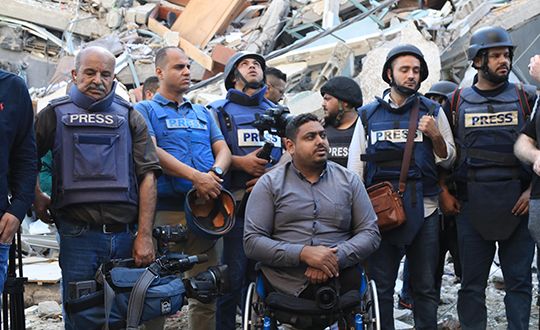
When fighting erupted in July 2025, local media became the primary source of information. Journalists documented casualties, displacement, and kidnappings in real time, even as rumors and hate speech spread online. Their work relied on shared ethical standards developed throughout the first war years and captured in an ethical charter co-organised by FPU and launched in 2015, including a complaints mechanism that was signed in 2021.
Partners also reported tangible shifts in newsroom practices: stronger internal verification procedures, increased attention to conflict-sensitive language, and more deliberate editorial discussions around sensitive reporting. One editor described how the programme influenced internal newsroom culture: “Before, sometimes we focused only on getting the story out first. Now we ask more questions internally: Who could be harmed by this? Are we amplifying a conflict? Are we sure about the information?”
FPU also helped move gender inclusion beyond individual advocacy toward organisational norms and shared professional expectations. Interviewees described growing awareness of gender-sensitive language, improved representation of women in reporting, and stronger attention to issues such as online harassment and gender-based violence targeting women journalists.
Collaboration and dialogue
The distinctive, unique role and central contribution of FPU is that of a steward. The evaluation finds that our organisation contributed significantly to strengthening collaboration and dialogue among Syrian independent media organisations operating across different geographies.
Given the transnational nature of Syrian media production, where many outlets operate simultaneously inside Syria, in neighbouring countries, and within the diaspora, collaboration has historically been difficult to sustain. FPU provides rare spaces where journalists and media organisations could engage in dialogue, share experiences, and develop joint initiatives.
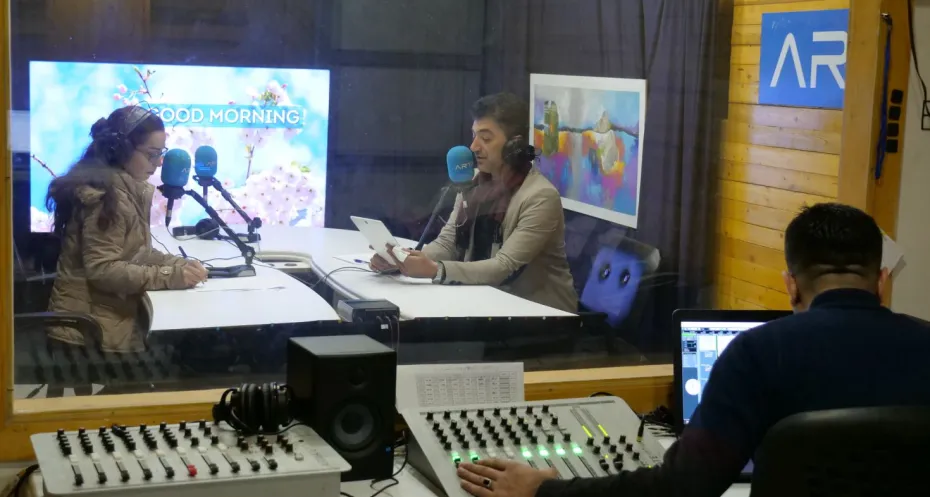
A consortium model involving outlets such as Arta, Rozana, and Enab Baladi produced 45 podcasts about local Syrian identities that reached over 1.2 million people on social media. Other examples of collaboration are joint coordinated editorial initiatives, cross-posting of content, and collective advocacy around societal issues such as social cohesion, reconciliation, and civic participation. One media editor described this shift: “Before this programme, we mostly worked in parallel. Now we sometimes plan together and think about the same issues from different angles.”
Reduce mistrust
Programme-supported dialogue spaces allowed journalists and editors to discuss politically sensitive issues, align terminology, and negotiate shared agendas during periods of heightened uncertainty. These discussions often addressed complex editorial questions related to conflict reporting, representation of different communities, and the role of media during political transition. Several respondents noted that these exchanges helped reduce mistrust between different actors and encouraged greater willingness to collaborate.
A recurring theme across interviews was FPU’s role in bridging exiled media professionals and journalists reporting inside Syria. Many Syrian independent media organisations rely on transnational operating models combining reporting from inside Syria with editorial leadership and production based in exile. Interviewees described programme-supported dialogue spaces as among the few settings where these actors could meaningfully engage with one another, reconcile different perspectives, and align editorial approaches. One journalist reporting from inside Syria noted: “Sometimes people outside the country don’t fully understand the risks we face on the ground. These discussions helped us find common ground.”
What's next
In the RSF Press Freedom Index of 2025, Syria was the biggest riser globally, climbing 36 places compared to the year before. Taken together, these findings indicate that Free Press Unlimited contributed to a gradual shift from fragmented and isolated media initiatives toward more collaborative and coordinated forms of professional practice within the Syrian independent media ecosystem.
The fall of the Assad regime in 2024 brought hope but also new dangers. Dialogue and cooperation have reached an impasse because partners have differing views on the future of the country. In this new political situation, the Syrian Journalists Association uses its leadership to stay critical and commit itself to stay independent and that no media should be under any control.
The most urgent need is simple: continued backing. The economy struggles to move from destruction and depression and the media market in Syria is very limited as well as influxed by foreign media. As one partner said, “Your presence reassures us that we are not alone”. For Syria’s independent media, that support has made the difference between silence and survival.