From tagging to targeting
How Palestinian journalists got labeled as terrorists, and how these allegations reached mainstream audiences and gained credibility through legacy media.
Anas Al-Sharif and Hossam Shabat reported from Gaza. After their deaths, a pro-Israel network spread allegations of terrorism against them without credible evidence. Free Press Unlimited investigated how these allegations were constructed, amplified and reproduced by international news media.
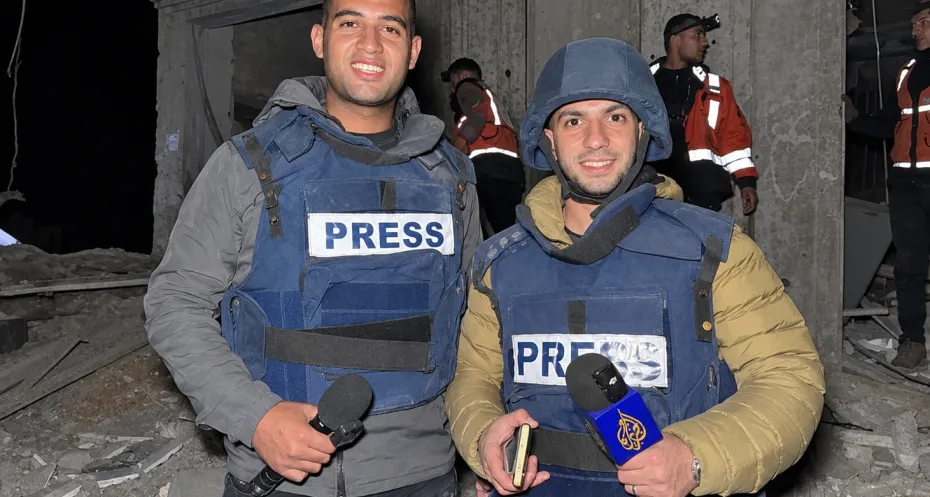
Anas Al-Sharif (right in the photo) was a Palestinian journalist reporting from Gaza for Al Jazeera. After 7 October 2023, he became one of the best-known journalistic faces reporting from Gaza. The Israeli military killed him in August 2025 and accused him of being a Hamas terrorist, without providing credible evidence of this claim.
Hossam Shabat (left in the photo) was a Palestinian journalist reporting from northern Gaza for Al Jazeera. Through his work, he brought the impact of the war to the attention of an international audience. The Israeli military killed him in March 2025 and accused him of being a Hamas terrorist, without providing credible evidence.
Key facts & figures
Why this matters
Under international humanitarian law, journalists are civilians and therefore not legitimate targets. Instead, states have an obligation to protect journalists. Citizens only lose their protection against direct attacks if they directly participate in hostilities.
Unfounded accusations of terrorism put journalists at risk. When such allegations gain traction and go unchallenged, they also weaken public scrutiny and international pressure to investigate attacks. This mechanism is not unique to Gaza.
Our call
Stop attacks on journalists and deligitimising Palestinian journalists. Make evidence for allegations public and verifiable.
Verify serious allegations independently. Offer a right to reply and provide sufficient context.
Investigate attacks on Palestinian journalists and hold Israel accountable for violations of its obligations under international humanitarian law.
Enforce monitoring guidelines about inciting and calls for violence against journalists.
Read the report
Read the full report and all the underlying findings. The report has been updated on November 20th, 2026 to include two factual corrections.
Right of reply
Before publication, we invited the parties involved, including the actors in the network and the news media, to respond to the findings of our investigation. This page provides an overview of the responses we received.
Bekijk onze uitlegvideo
Hoogleraar militair recht Marten Zwanenburg
"The analysis in the appendix provides a compelling basis for the conclusion that Israel has not made public conclusive evidence to substantiate the claim that Hossam Shabat and Anas Al-Sharif were legitimate military targets. As the analysis rightly states, journalists are civilians and therefore enjoy the same protection under international humanitarian law as other civilians. Direct attacks on civilians are only permitted when those civilians are directly participating in hostilities.
International humanitarian law treaties do not contain a definition of direct participation in hostilities. An authoritative definition is that of the ICRC, which is used as a starting point in the appendix. According to this definition, a civilian may be attacked when that civilian, at that moment, meets the three criteria set described by the ICRC, or when the civilian has a "continuous combat function." The latter means that their role within an organized armed group is to carry out acts that constitute direct participation in hostilities. It should be noted that the ICRC's interpretation does not enjoy universal consensus; Israel applies a different and broader interpretation.
The analysis clearly demonstrates that the information put forward by Israel and other sources does not provide conclusive evidence for the conclusion that Hossam Shabat and Anas Al-Sharif were directly participating in hostilities at the time they were killed, when the ICRC's interpretation is applied. Based on the analysis, it can also be concluded that even if the broader interpretation of direct participation in hostilities applied by Israel is used, the information that has been made public does not provide conclusive evidence that this threshold was met in the cases of Hossam Shabat and Anas Al-Sharif.
Relevant in this regard is, among others, that Israel has not released original documents, which means they cannot be independently verified; that the allegations against Hossam Shabat and Anas Al-Sharif are at times mutually contradictory; and that they fit a pattern in which Israel's claims regarding other journalists have already been refuted."